The Age of Information Overload

Scroll, Snack, Repeat

We live in a time of information abundance. It has become as plentiful—and as carefully engineered to exploit our every weakness—as modern processed food. The more content is optimized to manipulate our attention, the more our cognitive patterns are hijacked. Digital platforms are not only distracting; they reshape what we pay attention to and how we think.

The same cognitive patterns that once helped us survive by seeking vital free energy and novelty, now keep us locked in cycles of endless scrolling, technostress, and mental malnutrition. Worse, the more these systems optimize to capture our engagement, the harder it becomes to find truthful, nourishing ideas for the growth of humanity. Are we witnessing the edge of a Great Filter for intelligent life itself?

Overcoming this challenge will demand either drastically augmenting our cognitive ability to process the overflow of information, developing a brand new kind of immune system for the mind, or rapidly catalyzing the development of social care and compassion for other minds. Perhaps at this point, there is no choice but to pursue all three.
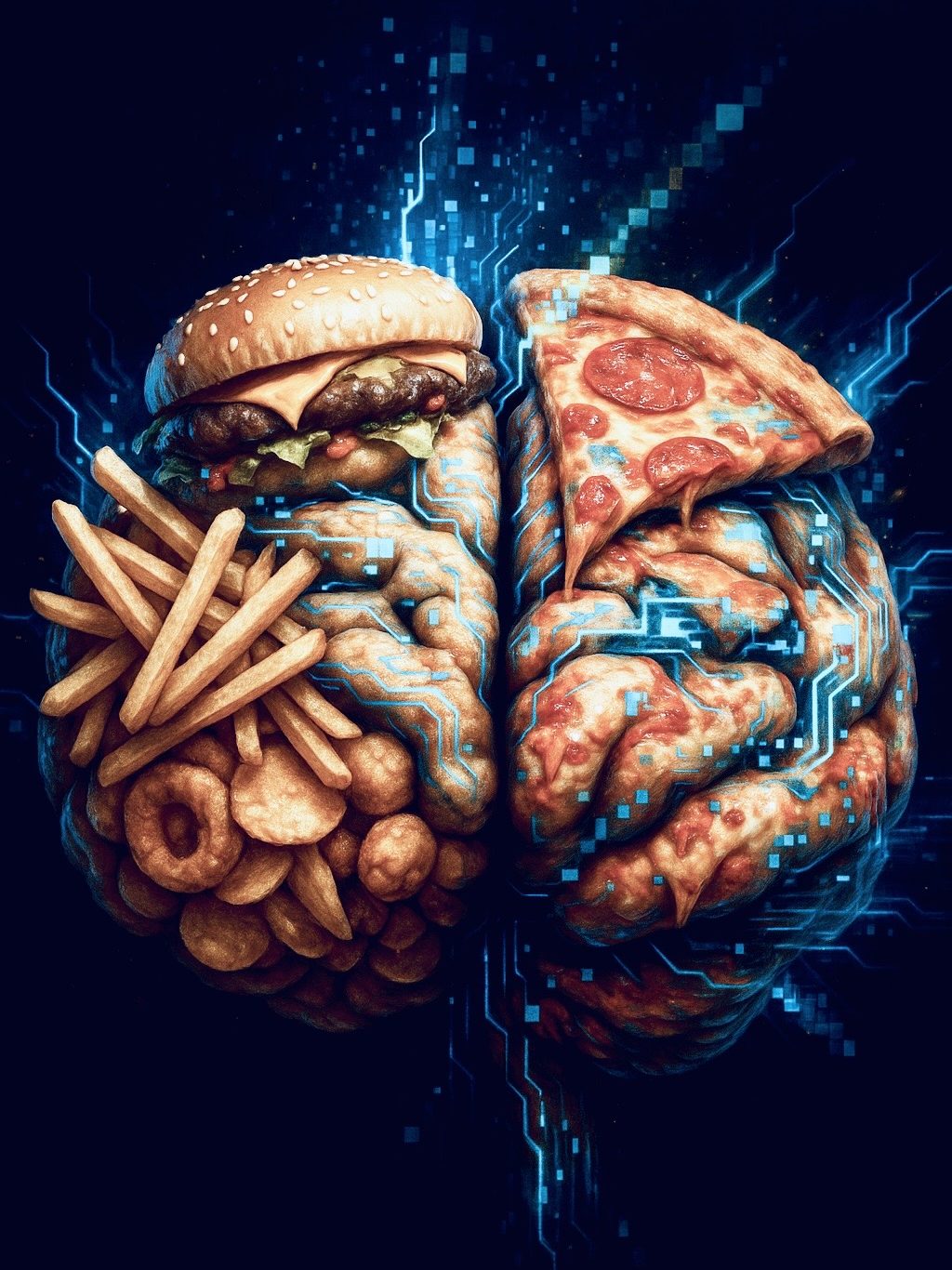
In this Age of Information Abundance, humans face an engineered deluge of manipulative digital information that exploits our every instinct; escaping it will demand strengthening our minds, mental immune systems, and shared compassion. Image Credit: Generated by Olaf Witkowski using DALL-E version 3, Jul 4, 2025.

Digital Addiction and Mind Starvation in the Attention Economy

This post was inspired to me by brilliant science communicator and author Hank Green’s recent thoughts on whether the internet is best compared to cigarettes or food (Green, 2025)—a brilliant meditation on addiction and the age of information abundance. Hank ultimately lands on the metaphor of food: the internet isn’t purely harmful like cigarettes. It’s become closer in dynamics to our modern food landscape, full of hyper-processed, hyper-palatable products. Some are nutritious. Many are engineered to hijack our lives.

This idea isn’t new. Ethologist Niko Tinbergen, who won the 1973 Nobel Prize in Biology, demonstrated that instinctive behaviors in animals could be triggered by what he coined supernormal stimuli—exaggerated triggers that mimic something once essential for survival—using creatively unrealistic dummies such as oversized fake eggs that birds preferred, red-bellied fish models that provoked attacks from male sticklebacks, and artificial butterflies that elicited mating behavior (Tinbergen, 1951). Philosopher Daniel Dennett (1995), pointed out how evolved drives can be hijacked by such supernormal stimuli, and how our minds, built by evolutionary processes to react predictably to certain signals, can thus be taken advantage of, often without our conscious awareness. Chocolate is a turbo-charged version of our drive to seek high-energy food, which we come to prefer to a healthier diet of fruits and vegetables. Nesting birds prefer oversized fake eggs over their own. Cuteness overload rides on our innate caregiving instincts to respond powerfully to cartoonish or exaggerated baby-like features such as large eyes, round faces, and small noses. Pornography exaggerates sexual cues to hijack evolved reproductive instincts, ending up producing stronger reactions than natural encounters.
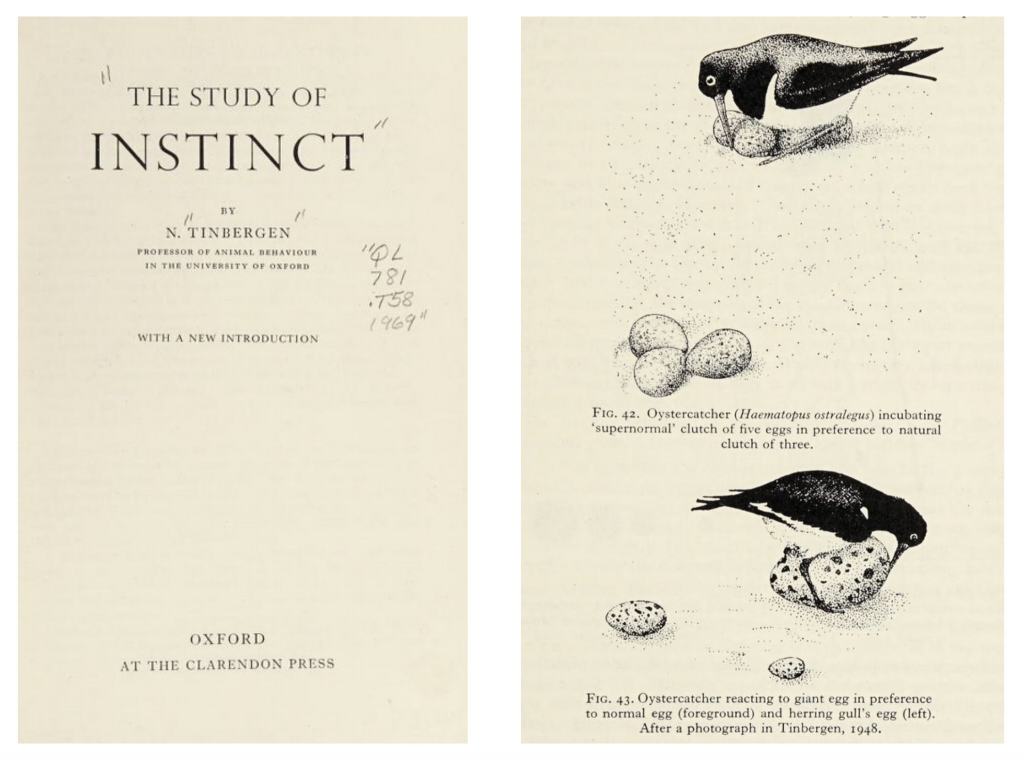
For most of our biological history, we humans have evolved in a world of information scarcity, where every piece of knowledge could be vital. Today, we turned into the central lane of the Information Age, where digital information has become a “supernormal stimuli”—coined by Nobel Prize Winner Niko Tinbergen—susceptible to manipulate our every thought and decision. Book reference: Tinbergen, N. (1951). The study of instinct. Oxford University Press.

And here we are with the internet. For most of our biological history, we have evolved in a world of information scarcity, where every piece of knowledge could be vital. Today, we turned into the central lane of the Information Age highway, pelted by an endless storm of content engineered to feel urgent, delicious, or enraging (Carr, 2010; McLuhan, 1964). It’s not that infotaxis—meant in the pure sense of information foraging, like chemotaxis is to chemical gradients—is inherently bad. It can be as helpful as Dennett’s food, sex, or caretaking-related instincts. But the environment has changed faster than our capacity to navigate it wisely. The same drives that helped our ancestors survive can now keep us scrolling endlessly, long past the point of nourishment. As Adam Alter (2017) describes, modern platforms are designed addictions—custom-engineered experiences that feed our craving for novelty while diminishing our sense of agency. Meanwhile, Shoshana Zuboff (2019) has shown how surveillance capitalism exploits these vulnerabilities systematically, capturing and monetizing attention at an unprecedented scale. And before that, pioneers like BJ Fogg (2003) have documented how persuasive technology can be designed to influence attitudes and behaviors, effectively reshaping our habits in subtle but powerful ways.

This is the core problem we face: the more these systems optimize for engagement, the harder it becomes to access truthful, useful, nourishing information—the kind that helps us think clearly and live well. What looks like an endless buffet of knowledge is often a maze of distraction, manipulation, and empty mental calories. In other words, the very abundance of content creates an environment where the most beneficial ideas are the hardest to find and the easiest to ignore.

Defending Global Access to Truthful Information

Shall we pause for a moment and acknowledge how ridiculously challenging it has become to search for information online? Some of us can certainly remember times and versions of the Internet in which it wasn’t all that difficult to find an article, a picture, or a quote we’d seen before. Of course, information was once easier to retrieve because there was less overwhelming abundance, and part of this is due to the increasing incentives to flood us with manipulative content. But beyond simply the challenge of locating something familiar, it has also become much harder to know what source to trust. The same platforms that bury useful information under endless novelty also strip away the signals that once helped us judge credibility, leaving us adrift in a sea where misinformation and insight are nearly indistinguishable.

Red Queen’s race between cyberattacks from ads-based social media and systems protecting our mental health. Image Credit: Generated by Olaf Witkowski using DALL-E version 3, Jul 4, 2025.

So how do we adapt? I think we have three broad paths. One is to augment our cognitive capacity—to build better tools, shared knowledge systems, and personal practices that help us sort signal from noise. This practice relies on an open field Red Queen’s race between mental cyberattacks for advertisement and protective systems trying to figure out how to transmit information. It’s not impossible. Just costly—to the extent it may render this way nonviable. This is the path of cryptography.

The second is to bury the signal itself. We can hide cognitive paths, and the channels we really use to communicate survival information with each other or within our own bodies, through a collection of local concealment strategies and obfuscation mechanisms. Even our body’s immune system, rooted in the cryptographic paradigm (Krakauer, 2015), works by obscuring and complicating access to its key processes to resist exploitation by external—as well as internal—parasites. Biological processes like antigen mimicry, chemical noise for camouflage, or viral epitope masking do involve concealment and obfuscation of vital information—meaning access to the organism’s free energy. Protecting by building walls—which means exploiting inherent asymmetries present in the underlying physical substrate—can incur great costs. In many cases, making information channels covert, albeit at the expense of signal openness and transparency, can be a cheaper tactic. This second path is called steganography.

The third and final path is to increase trust and care among humans—and the other agents, biological or artificial, with whom we co-create our experience in the world. Everyone can help tend each other’s mental health and safety. Just as we have learned to protect and heal each other’s bodies, we will need to learn to protect each other’s minds.  This means allowing our emerging, co-evolving systems of human and non-human agents to develop empathy, shared responsibility, and trust, so that manipulative systems and predatory incentives cannot so easily exploit our vulnerabilities. This was the focus of my doctoral dissertation, which examined the fundamental principles and practical conditions by which a system composed of populations of competing agents could eventually give rise to trust and cooperation. The solution calls for reimagining the architectures of our social, technological, and economic institutions so they align with mutual care, and cultivating diverse mixtures of cultures that value psychological safety at an individual and global level. This is the path of care, compassion, and social resilience.

We’re only beginning to build the cultural tools to deal with this. Naming the dynamic—seeing how our attention gets manipulated and why it makes truth harder to reach—is the first step. Maybe the question isn’t whether the internet is cigarettes or food. Maybe it’s whether we can learn to distinguish empty calories from real sustenance, and whether we can do it together—helping each other flourish in a world too full.

Overcoming Mental Cyberattacks with Tools for Care and Reflection

I’ve seen people throwing technology at it: why don’t we use ChatGPT to steward our consumption of information. I’m all in favor of having AI mentor us—it holds many values, and I’m myself engaged in various projects developing this kind of technology for mindful education and personalized mentorship. But this presents a risk, which we can’t afford to ignore: these new proxies are so, so very susceptible to being hijacked themselves. Jailbreaks, hijacking, man-in-the-middle attack, you name it. LLMs are weak, and—take it from someone whose training came from cryptography and is spending large efforts on LLM cyberdefense—will remain so for many years. Actually, LLMs haven’t even gone through the test of any significant time like our original cognitive algorithms have—our whole biology relies on layer on layer of protections and immune systems shielding us from ourselves—from self-exposition to injuries, germs, harmful bacteria, viruses and harm of countless sorts and forms. This is why we don’t need to live in constant fear of death and suffering on a daily basis. But technology is a new vector for new diseases—many of which unidentified.

To protect our mental health, education ought to adapt quickly in the Age of Information Overload.
Credit: Jamie Gill / Getty Images

We need to learn to deal with such new threats in this changing world. The internet. Entertainment. Our ways of healthy life. How we raise our children. The entire design of education itself must evolve. We need new schools—institutions built not just to transmit knowledge but to help us develop the discernment, resilience, and collective care needed to thrive amid infinite information. It’s no longer about preparing for yesterday’s challenges. It’s about learning to navigate a world where our instincts are constantly manipulated and where reflection, curiosity, and shared wisdom are our best defenses against mental malnutrition. It’s time to work on incorporating care and reflection in our technolives—acknowledgedly, we can’t not recognize our lives are going to be technological too, and we also need to accept it and focus on symbiotizing with the technological rather fighting it—which requires in turn to help catalyze a protective niche of care and reflection-oriented technosociety around it. Let’s develop a healthcare system for our minds.

DOI: 10.54854/ow2025.07

References

Alter, A. (2018). Irresistible: The rise of addictive technology and the business of keeping us hooked. Penguin.

Carr, N. (2020). The shallows: What the Internet is doing to our brains. WW Norton & Company.

Dennett, D. C. (1995). Darwin’s Dangerous Idea: Evolution and the Meanings of Life (No. 39). Simon and Schuster.

Fogg, B. J. (2002). Persuasive technology: Using computers to change what we think and do. Ubiquity, 2002(December), 2.

Green, H. (2025, June 28). You’re not addicted to content, you’re starving for information [Video]. YouTube.

Krakauer, D. Cryptographic Nature. arXiv 2015. arXiv preprint arXiv:1505.01744.

McLuhan, M. (1994). Understanding media: The extensions of man. MIT press.

Tinbergen, N. (1951). The study of instinct. Oxford University Press.

Zuboff, S. (2023). The age of surveillance capitalism. In Social theory re-wired (pp. 203-213). Routledge.

AI-to-AI Communication: Unpacking Gibberlink, Secrecy, and New AI Communication Channels

AI communication channels may represent the next major technological leap, driving more efficient interaction between agents—artificial or not. While recent projects like Gibberlink demonstrate AI optimizing exchanges beyond the constraints of human language, fears of hidden AI languages must be correctly debunked. The real challenge is balancing efficiency with transparency, ensuring AI serves as a bridge—not a barrier—in both machine and human-AI communication.

Coding on a computer screen by Markus Spiske is licensed under CC-CC0 1.0

At the ElevenLabs AI hackathon in London last month, developers Boris Starkov and Anton Pidkuiko introduced a proof-of-concept program called Gibberlink.  The project features two AI agents that start by conversing in human language, recognizing each other as AI, before switching to a more efficient protocol using chirping audio signals. The demonstration highlights how AI communication can be optimized when unhinged from the constraints of human-interpretable language.

While Gibberlink points to a valuable technological direction in the evolution of AI-to-AI communication—one that has rightfully captured public imagination—it remains but an early-stage prototype relying so far on rudimentary principles from signal processing and coding theory. Actually, Starkov and Pidkuiko themselves emphasized that Gibberlink’s underlying technology isn’t new: it dates back to the dial-up internet modems of the 1980s. Its use of FSK modulation and Reed-Solomon error correction to generate compact signals, while a good design, falls short of modern advances, leaving substantial room for improvement in bandwidth, adaptive coding, and multi-modal AI interaction.

Gibberlink, Global Winner of ElevenLabs 2025 Hackathon London. The prototype demonstrated how two AI agents started a normal phone call about a hotel booking, then discovered they both are AI, and decided to switch from verbal english to a more efficient open standard data-over-sound protocol ggwave. Code: https://github.com/PennyroyalTea/gibberlink Video Credit: Boris Starkov and Anton Pidkuiko

Media coverage has also misled the public, overstating the risks of AI concealing information from humans and fueling speculative narratives—sensationalizing real technical challenges into false yet compelling storytelling. While AI-to-AI communication can branch out of human language for efficiency, it has already done so across multiple domains of application without implying any deception or harmful consequences from meaning obscuration. Unbounded by truth-inducing mechanisms, social media have amplified unfounded fears about malicious AI developing secret languages beyond human oversight—ironically, more effort in AI communication research may actually enhance transparency by discovering safer ad-hoc protocols, reducing ambiguity, embedding oversight meta-mechanisms, and in term improving explainability and enhancing human-AI collaboration, ensuring greater transparency and accountability.

In this post, let us take a closer look at this promising trajectory of AI research, unpacking these misconceptions while examining its technical aspects and broader significance. This development builds on longstanding challenges in AI communication, representing an important innovation path with far-reaching implications for the future of machine interfaces and autonomous systems.

Debunking AI Secret Language Myths

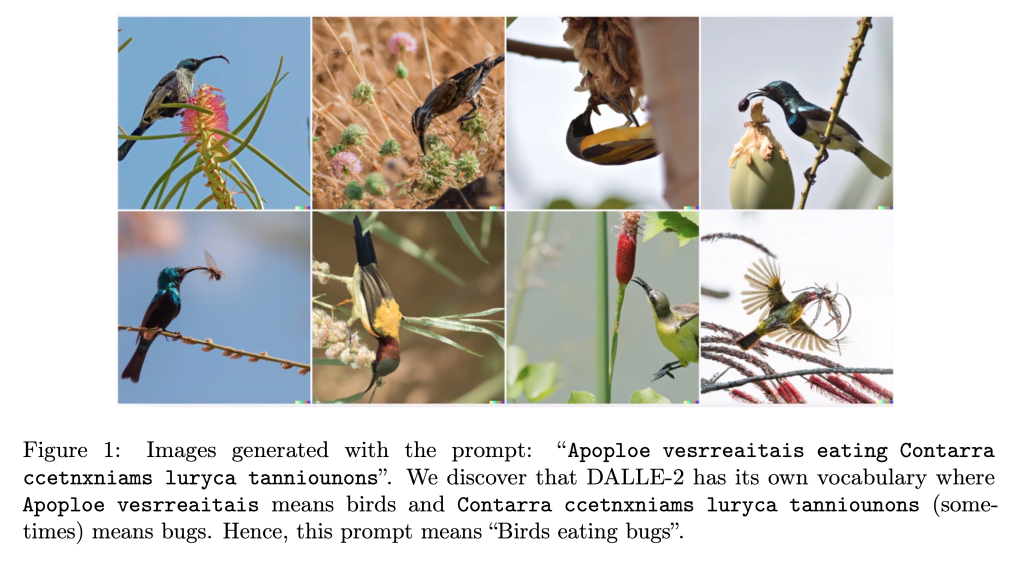
Claims that AI is developing fully-fledged secret languages—allegedly to evade human oversight—have periodically surfaced in the media. While risks related to AI communication exist, such claims are often rooted in misinterpretations of the optimization processes that shape AI behavior and interactions. Let’s explore three examples. In 2017, we remember the story around Facebook AI agents streamlining negotiation dialogues, which far from being a surprising emergent phenomenon, merely amounted to a predictable outcome of reinforcement learning, mistakenly seen by humans as a cryptic language (Lewis et al., 2017). Similarly, a couple of years ago, OpenAI’s DALL·E 2 seemed to be responding to gibberish prompts, sparked widespread discussion, often misinterpreted as AI developing a secret language. In reality, this behavior is best explained by how AI models process text through embedding spaces, tokenization, and learned associations rather than intentional linguistic structures. What seemed like a secret language to some, may be closer to low-confidence neural activations, akin to mishearing lyrics, rather than a real language.

Source: Daras & Dimakis (2022)

Models like DALL·E (Ramesh et al., 2021) map words and concepts as high-dimensional vectors, and seemingly random strings can, by chance, land in regions of this space linked to specific visuals. Built from a discrete variational autoencoder (VAE), an autoregressive decoder-only transformer similar to GPT-3, and a CLIP-based pair of image and text encoders, DALL·E processes text prompts by first tokenizing them using Byte-Pair Encoding (BPE). Since BPE breaks text into subword units rather than whole words, we should also note that even gibberish inputs can be decomposed into meaningful token sequences for which the model has learned associations. These tokenized representations are then mapped into DALL·E’s embedding space via CLIP’s text encoder, where they may, by chance, activate specific visual concepts. This understanding of training and inference mechanisms highlights intriguing quirks, explaining why nonsensical strings sometimes produce unexpected yet consistent outputs, with important implications for adversarial attacks and content moderation (Millière, 2023). While there is no proper hidden language to be found, analyzing the complex interactions within model architectures and data representations can reveal vulnerabilities and security risks, which may are likely to occur at their interface with humans, and will need to be addressed.

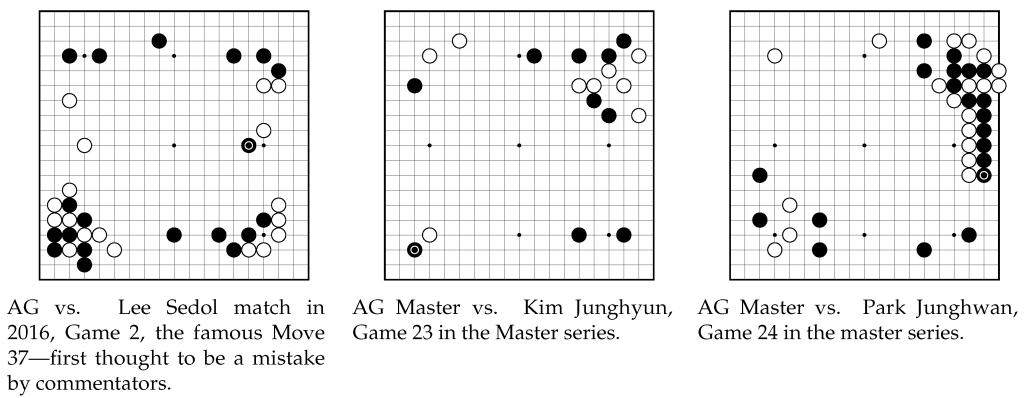
One third and more creative connection may be found in the reinforcement learning and guided search domain, with AlphaGo, which developed compressed, task-specific representations to optimize gameplay, much like expert shorthand (Silver et al., 2017). Rather than relying on explicit human instructions, it encoded board states and strategies into efficient, unintuitive representations, refining itself through reinforcement learning. The approach somewhat aligns with the argument by Lake et al. (2017) that human-like intelligence requires decomposing knowledge into structured, reusable compositional parts and causal links, rather than mere brute-force statistical correlation and pattern recognition—like Deep Blue back in the days. However, AlphaGo’s ability to generalize strategic principles from experience used different mechanisms from human cognition, illustrating how AI can develop domain-specific efficiency without explicit symbolic reasoning. This compression of knowledge, while opaque to humans, is an optimization strategy, not an act of secrecy.

Illustration of AlphaGo’s representations being able to capture tactical and strategic principles of the game of go. Source: Egri-Nagy & Törmänen (2020)

Fast forward to the recent Gibberlink prototype, with AI agents switching from English to a sound-based protocol for efficiency, is a deliberately programmed optimization. Media narratives framing this as dangerous slippery slope towards AI secrecy overlook that such instances are explicitly programmed optimizations, not emergent deception. These systems are designed to prioritize efficiency in communication, not to obscure meaning, although there might be some effects on transparency—which may be carefully addressed and mediated, if it were the point of focus.

The Architecture of Efficient Languages

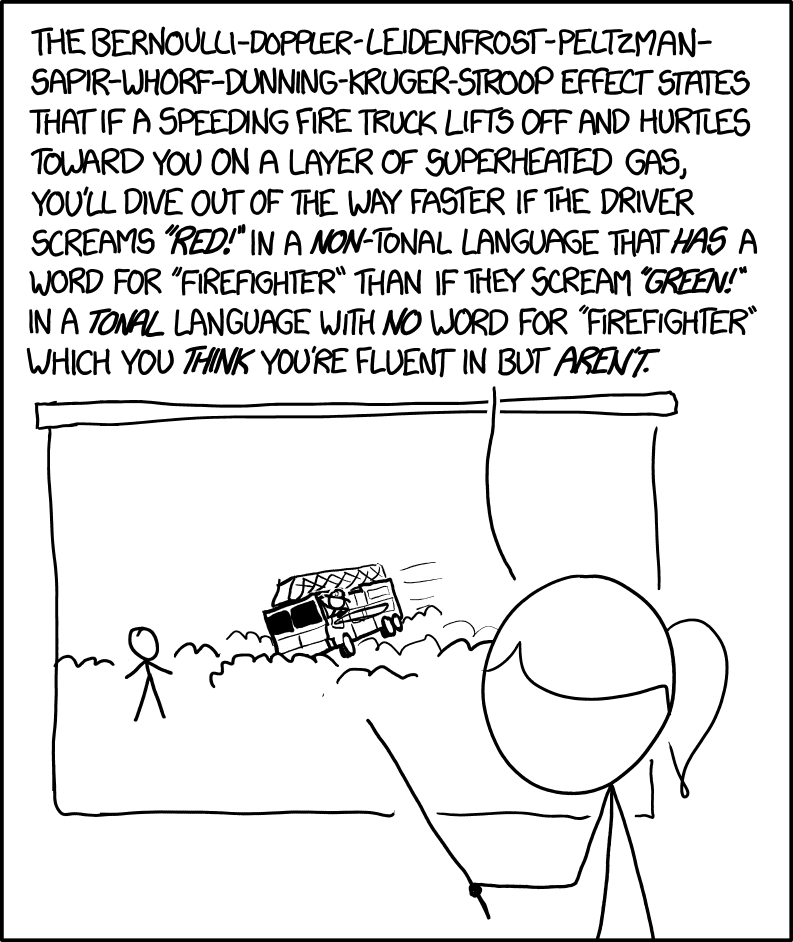
​In practice, AI-to-AI communication naturally gravitates toward faster, more reliable channels, such as electrical signaling, fiber-optic transmission, and electromagnetic waves, rather than prioritizing human readability. However, one does not preclude the other, as communication can still incorporate “subtitling” for oversight and transparency. The choice of a communication language does not inherently prevent translations, meta-reports, or summaries from being generated for secondary audiences beyond the primary recipient. While arguments could be made that the choice of language influences ranges of meanings that can be conveyed—with perspectives akin to the Sapir-Whorf hypothesis and related linguistic relativity—this introduces a more nuanced discussion on the interaction between language structure, perception, and cognition (Whorf, 1956; Leavitt, 2010).

Source: https://xkcd.com/1531/ Credit: Randall Munroe

​Language efficiency, extensively studied in linguistics and information theory (Shannon, 1948; Gallager, 1962; Zipf, 1949), drives AI to streamline interactions much like human shorthand. For an interesting piece of research that takes information-theoretic tools to characterize natural languages, Coupé et al. (2011) showed that, regardless of speech rate, languages tend to transmit information at an approximate rate of 39 bits per second. This, in turn, suggested a universal constraint on processing efficiency, which again connects with linguistic relativity . While concerns about AI interpretability and security are valid, they should be grounded in technical realities rather than speculative fears. Understanding how AI processes and optimizes information clarifies potential vulnerabilities—particularly at the AI-human interface—without assuming secrecy or intent. AI communication reflects engineering constraints, not scheming, reinforcing the need for informed discussions on transparency, governance, and security.

This figure from Coupé et al.’s study illustrates that, despite significant variations in speech rate (SR) and information density (ID) across 17 languages, the overall information rate (IR) remains consistent at approximately 39 bits per second. This consistency suggests that languages have evolved to balance SR and ID, ensuring efficient information transmission. ​Source: Coupé et al. (2011)

AI systems are become more omnipresent, and will increasingly need to interface with each other in an autonomous manner. This will require the development of more specialized communication protocols, either by human design, or continuous evolution of such protocols—and probably various mixtures of both. We may then witness emergent properties akin to those seen in natural languages—where efficiency, redundancy, and adaptability evolve in response to environmental constraints. Studying these dynamics could not only enhance AI transparency but also provide deeper insights into the future architectures and fundamental principles governing both artificial and human language.

When AI Should Stick to Human Language

Despite the potential for optimized AI-to-AI protocols, there are contexts where retaining human-readable communication is crucial. Fields involving direct human interaction—such as healthcare diagnostics, customer support, education, legal systems, and collaborative scientific research—necessitate transparency and interpretability. However, it is important to recognize that even communication in human languages can become opaque due to technical jargon and domain-specific shorthand, complicating external oversight.​

AI can similarly embed meaning through techniques analogous to human code-switching, leveraging the idea behind the Sapir-Whorf hypothesis (Whorf, 1956), whereby language influences cognitive structure. AI will naturally gravitate toward protocols optimized for their contexts, effectively speaking specialized “languages.” In some cases, this is explicitly cryptographic—making messages unreadable without specific decryption keys, even if the underlying language is known (Diffie & Hellman, 1976). AI systems could also employ sophisticated steganographic techniques, embedding subtle messages within ordinary-looking data, or leverage adversarial code obfuscation and data perturbations familiar from computer security research (Fridrich, 2009; Goodfellow et al., 2014). These practices reflect optimization and security measures rather than sinister intent.​

Photo by Yan Krukau on Pexels.com

Gibberlink, Under the Hood

Gibberlink operates by detecting when two AI agents recognize each other as artificial intelligences. Upon recognition, the agents transition from standard human speech to a faster data-over-audio format called ggwave. The modulation approach employed is Frequency-Shift Keying (FSK), specifically a multi-frequency variant. Data is split into 4-bit segments, each transmitted simultaneously via multiple audio tones in a predefined frequency range (either ultrasonic or audible, depending on the protocol settings). These audio signals cover a 4.5kHz frequency spectrum divided into 96 equally spaced frequencies, utilizing Reed-Solomon error correction for data reliability. Received audio data is decoded using Fourier transforms to reconstruct the original binary information.​

Although conceptually elegant, this approach remains relatively basic compared to established methods in modern telecommunications. For example, advanced modulation schemes such as Orthogonal Frequency-Division Multiplexing (OFDM), Spread Spectrum modulation, and channel-specific encoding techniques like Low-Density Parity-Check (LDPC) and Turbo Codes could dramatically enhance reliability, speed, and overall efficiency. Future AI-to-AI communication protocols will undoubtedly leverage these existing advancements, transcending the simplistic methods currently seen in demonstrations such as Gibberlink.

This is a short demonstration of ggwave in action. A console application, a GUI desktop program and a mobile app are communicating through sound using ggwave. Source code: https://github.com/ggerganov/ggwave Credit: Georgi Gerganov

New AI-Mediated Channels for Human Communication

Beyond internal AI-to-AI exchanges, artificial intelligence increasingly mediates human interactions across multiple domains. AI can augment human communication through real-time translation, summarization, and adaptive content filtering, shaping our social, professional, and personal interactions (Hovy & Spruit, 2016). This growing AI-human hybridization blurs traditional boundaries of agency, raising complex ethical and practical questions. It becomes unclear who authors a message, makes a decision, or takes an action—the human user, their technological partner, or a specific mixture of both. With authorship, of course, comes responsibility and accountability. Navigating this space is a thin rope to walk, as over-reliance on AI risks diminishing human autonomy, while restrictive policies may stifle innovation. Continuous research in this area is key. If approached thoughtfully, AI can serve as a cognitive prosthetic, enhancing communication while preserving user intent and accountability (Floridi & Cowls, 2019).

Thoughtfully managed, this AI-human collaboration will feel intuitive and natural. Rather than perceiving AI systems as external tools, users will gradually incorporate them into their cognitive landscape. Consider the pianist analogy: When an experienced musician plays, they no longer consciously manage each muscle movement or keystroke. Instead, their cognitive attention focuses on expressing emotions, interpreting musical structures, and engaging creatively. Similarly, as AI interfaces mature, human users will interact fluidly and intuitively, without conscious translation or micromanagement, elevating cognition and decision-making to new creative heights.

Ethical issues and how to address them were addressed by our two panelist speakers, Dr. Pattie Maes (MIT Media Lab) and Dr. Daniel Helman (Winkle Institute), at the final session of the New Human Interfaces Hackathon, part of Cross Labs’ annual workshop 2025.

What Would Linguistic Integration Between Humans and AI Entail?

Future AI-human cognitive integration may follow linguistic pathways familiar from human communication studies. Humans frequently switch between languages (code-switching), blend languages into creoles, or evolve entirely new hybrid linguistic structures. AI-human interaction could similarly generate new languages or hybrid protocols, evolving dynamically based on situational needs, cognitive ease, and efficiency.

Ultimately, Gibberlink offers a useful but modest illustration of a much broader trend: artificial intelligence will naturally evolve optimized communication strategies tailored to specific contexts and constraints. Rather than generating paranoia over secrecy or loss of control, our focus should shift toward thoughtfully managing the integration of AI into our cognitive and communicative processes. If handled carefully, AI can serve as a seamless cognitive extension—amplifying human creativity, enhancing our natural communication capabilities, and enriching human experience far beyond current limits.

Gibberlink’s clever demonstration underscores that AI optimization of communication protocols is inevitable and inherently beneficial, not a sinister threat. The pressing issue is not AI secretly communicating; rather, it’s about thoughtfully integrating AI as an intuitive cognitive extension, allowing humans and machines to communicate and collaborate seamlessly. The future isn’t about AI concealing messages from us—it’s about AI enabling richer, more meaningful communication and deeper cognitive connections.


References

  • Coupé, C., Oh, Y. M., Dediu, D., & Pellegrino, F. (2019). Different languages, similar encoding efficiency: Comparable information rates across the human communicative niche. Science Advances, 5(9), eaaw2594. https://doi.org/10.1126/sciadv.aaw2594
  • Cowls, J., King, T., Taddeo, M., & Floridi, L. (2019). Designing AI for social good: Seven essential factors. Available at SSRN 3388669.
  • Daras, G., & Dimakis, A. G. (2022). Discovering the hidden vocabulary of dalle-2. arXiv preprint arXiv:2206.00169.
  • Diffie, W., & Hellman, M. (1976). New directions in cryptography. IEEE Transactions on Information Theory, 22(6), 644-654.
  • Egri-Nagy, A., & Törmänen, A. (2020). The game is not over yet—go in the post-alphago era. Philosophies, 5(4), 37.
  • Fridrich, J. (2009). Steganography in digital media: Principles, algorithms, and applications. Cambridge University Press.
  • Gallager, R. G. (1962). Low-density parity-check codes. IRE Transactions on Information Theory, 8(1), 21-28.
  • Goodfellow, I., Shlens, J., & Szegedy, C. (2014). Explaining and harnessing adversarial examples. arXiv preprint arXiv:1412.6572.
  • Leavitt, J. H. (2010). Linguistic relativities: Language diversity and modern thought. Cambridge University Press. https://doi.org/10.1017/CBO9780511992681
  • LeCun, Y., Bengio, Y., & Hinton, G. (2015). Deep learning. Nature, 521(7553), 436-444.
  • Lewis, M., Yarats, D., Dauphin, Y. N., Parikh, D., & Batra, D. (2017). Deal or no deal? End-to-end learning for negotiation dialogues. arXiv:1706.05125.
  • Millière, R. (2023). Adversarial attacks on image generation with made-up words: Macaronic prompting and the emergence of DALL·E 2’s hidden vocabulary.
  • Ramesh, A. et al. (2021). Zero-shot text-to-image generation. arXiv:2102.12092.
  • Shannon, C. E. (1948). A mathematical theory of communication. Bell System Technical Journal, 27(3), 379-423.
  • Silver, D. et al. (2017). Mastering the game of Go without human knowledge. Nature, 550(7676), 354-359.
  • Whorf, B. L. (1956). Language, thought, and reality. MIT Press.
  • Zipf, G. K. (1949). Human behavior and the principle of least effort: An introduction to human ecology. Addison-Wesley.​

DOI: http://doi.org/10.54854/ow2025.03